

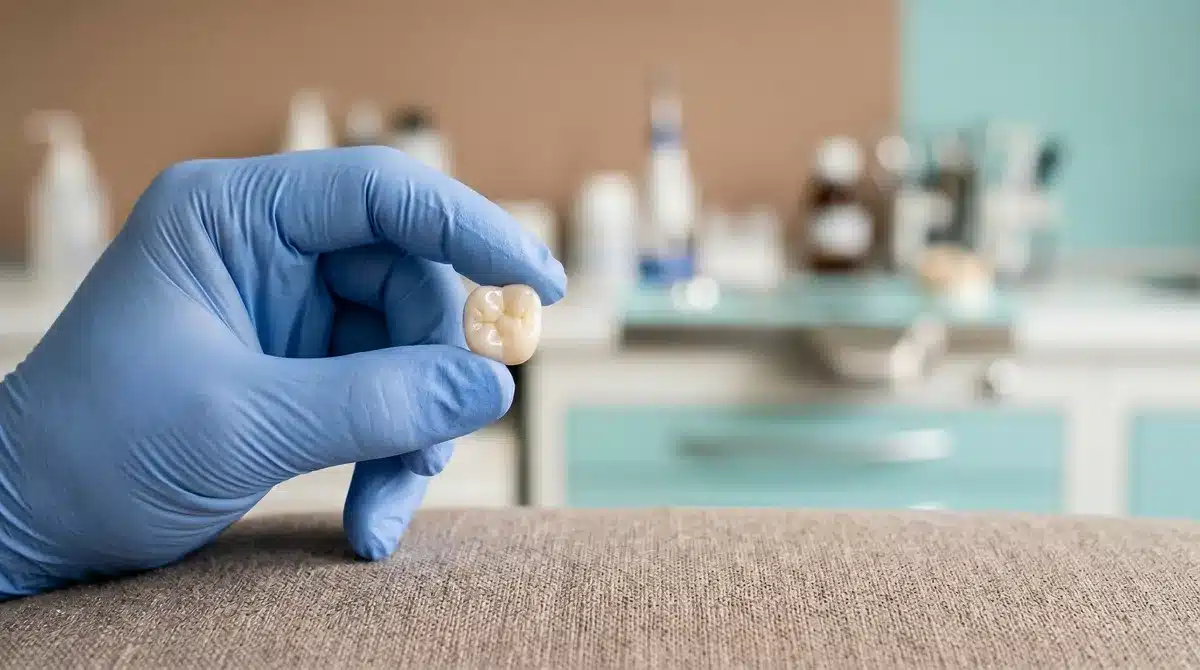
How much does a dental crown cost in 2026? In Quebec, the dental crown cost typically ranges between $900 and $1,500 per tooth, all inclusive. The price depends on the material (porcelain, zirconia, porcelain-fused-to-metal), the position of the tooth, the complexity of the preparation, and the dental laboratory used. In Brossard, most crowns placed at Centre dentaire Taschereau fall within this range.
This guide explains why the price varies from one case to another, what your dental insurance generally covers, and how to avoid hidden costs. The information reflects the 2026 Fee Guide of the Association des chirurgiens dentistes du Québec (ACDQ) and our day-to-day practice in Brossard.
Table of contents
Key points
| Price range | $900 to $1,500 per tooth, all inclusive, per the 2026 ACDQ Fee Guide. |
| Materials | Porcelain-fused-to-metal (PFM), all-ceramic (e.max), monolithic zirconia. |
| Lifespan | 10 to 15 years for PFM and e.max; 15+ years for zirconia. |
| Insurance | Private: 50% – 80% under major services. RAMQ: not covered (adult). CDCP: eligible patients. |
Dental crown cost in 2026: the price range
Here are the typical Quebec price ranges in 2026 by crown type:
| Crown type | Cost per tooth (2026) | Lifespan | Main indication |
|---|---|---|---|
| Porcelain-fused-to-metal (PFM) | $900 – $1,200 | 10 to 15 years | Posterior molars, tight budget |
| All-ceramic (e.max) | $1,100 – $1,400 | 10 to 15 years | Front teeth, high aesthetics |
| Monolithic zirconia | $1,200 – $1,500 | 15+ years | Molars, bruxism |
| Temporary crown | Included | 2 to 4 weeks | Between appointments |
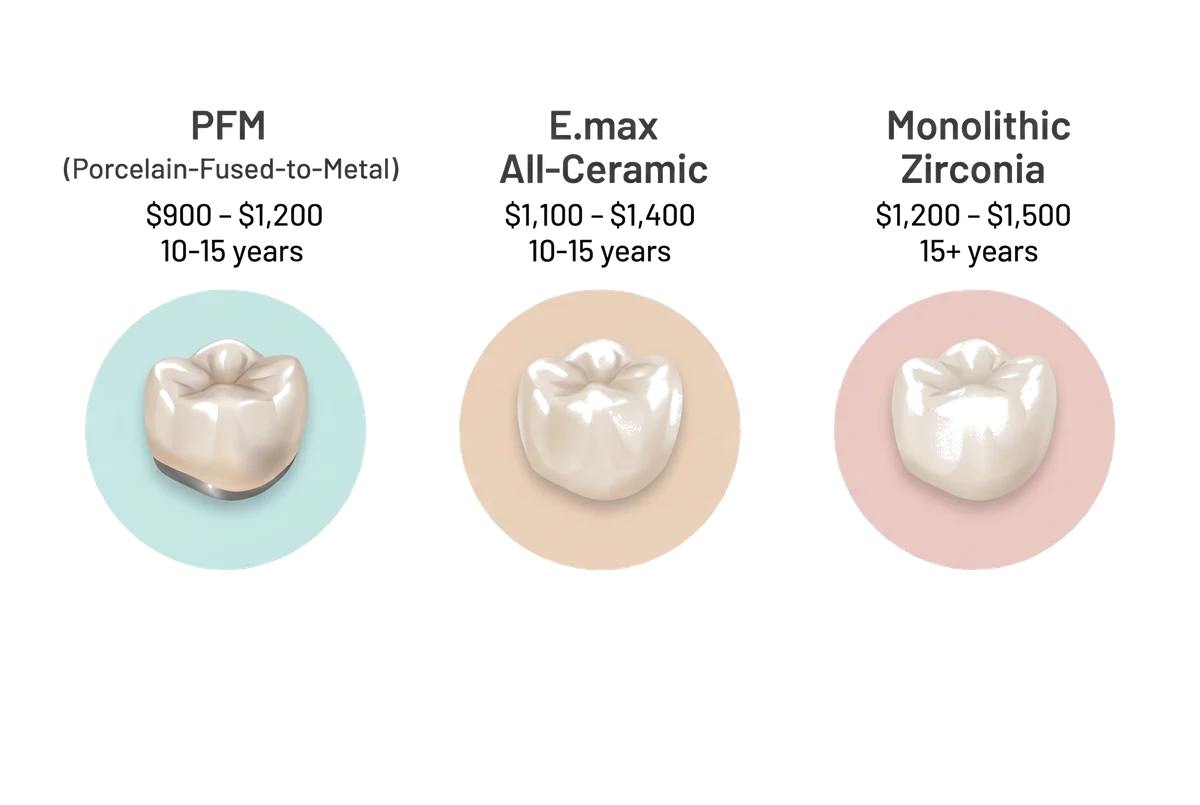
Prices are indicative and based on the 2026 ACDQ Fee Guide. The final fee is confirmed after the clinical exam. X-ray, local anesthesia and final cementation are included.
Why $900 to $1,500? The 6 factors that move the price
1. The crown material
This is the biggest single factor. Porcelain-fused-to-metal (PFM) remains the most economical option because it uses a metal core covered with porcelain — a technique proven since the 1960s. All-ceramic crowns (e.max) are more translucent and look more natural on a visible tooth, but they require a more demanding bonding protocol. Monolithic zirconia is the strongest material: we favour it for patients who grind their teeth (bruxism) or who need a crown on a heavily loaded molar.
2. The position of the tooth
A crown on an incisor or a canine (visible zone) requires finer shade work and translucency layering — that pushes you toward the upper end of the range. A crown on a posterior molar can usually be made in monolithic zirconia or PFM with no aesthetic compromise.
3. Preparation complexity
If the tooth has lost a lot of structure (deep decay, fracture), a core build-up may be needed before the crown can be placed. This step is billed separately (typically $200 to $350) and is not included in the crown fee itself.
4. Prior root canal treatment
If the tooth needs to be devitalized before receiving the crown, the root canal is billed separately (typically $900 to $1,600 depending on the number of canals). A crown on a root-canal-treated tooth is almost always indicated to prevent a later vertical fracture.
5. The technology used
CAD/CAM crowns (computer-designed and milled at the lab) offer a superior marginal fit, though the cost can be slightly higher than a crown made with the traditional lost-wax technique. Long-term, a better fit reduces the risk of recurrent decay under the crown.
6. The dental laboratory
A crown made by a Quebec or Canadian laboratory costs slightly more than a crown outsourced overseas, but quality control, material traceability and Health Canada compliance are superior. We work with Quebec-based labs.
Insurance coverage: what’s left for you to pay?
Most private dental plans cover crowns under the “major services” category, with typical reimbursement of 50% to 80%, up to the annual maximum of the policy (often $1,500 to $2,500 per year). In practice:
- $1,000 PFM crown, 50% reimbursement → you pay about $500.
- $1,400 zirconia crown, 80% reimbursement → you pay about $280.
The RAMQ does not cover crowns for adults. The Canadian Dental Care Plan (CDCP) has covered certain crowns for eligible patients since 2024, under specific conditions and with pre-authorization — bring your member number to your consultation so we can verify your coverage.
We provide a written treatment plan with cost estimate before any work begins. You can submit it to your insurer for pre-authorization and know your out-of-pocket cost in advance.
What does the cost actually cover?
A $1,200 dental crown typically includes:
- The initial exam and targeted X-ray (the full diagnosis may be billed separately at the consultation).
- Local anesthesia and tooth preparation (reduction of approximately 1.5 to 2 mm of tooth structure).
- Digital or conventional impression.
- A temporary crown for the 2–4 week waiting period.
- Fabrication at a qualified dental laboratory.
- Final placement, cementation and occlusal adjustment.
- A follow-up check a few weeks later.
Crown or no crown? When is it actually indicated?
A dental crown is justified when:
- A tooth has undergone root canal treatment — the crown prevents vertical fracture.
- A large cavity has destroyed more than 50% of the tooth structure.
- A tooth is fractured or shows a deep crack line.
- A very large existing filling (amalgam or composite) is failing.
- The patient wishes to correct the shape or shade of a visible tooth (aesthetic option).
Conversely, if the tooth still has more than 60% of healthy structure, a composite filling ($200 – $450) or a ceramic inlay/onlay ($700 – $1,100) can be a more conservative alternative. At your exam in Brossard, our team will explain which option fits your case best.
How is a crown placed? The two-appointment procedure
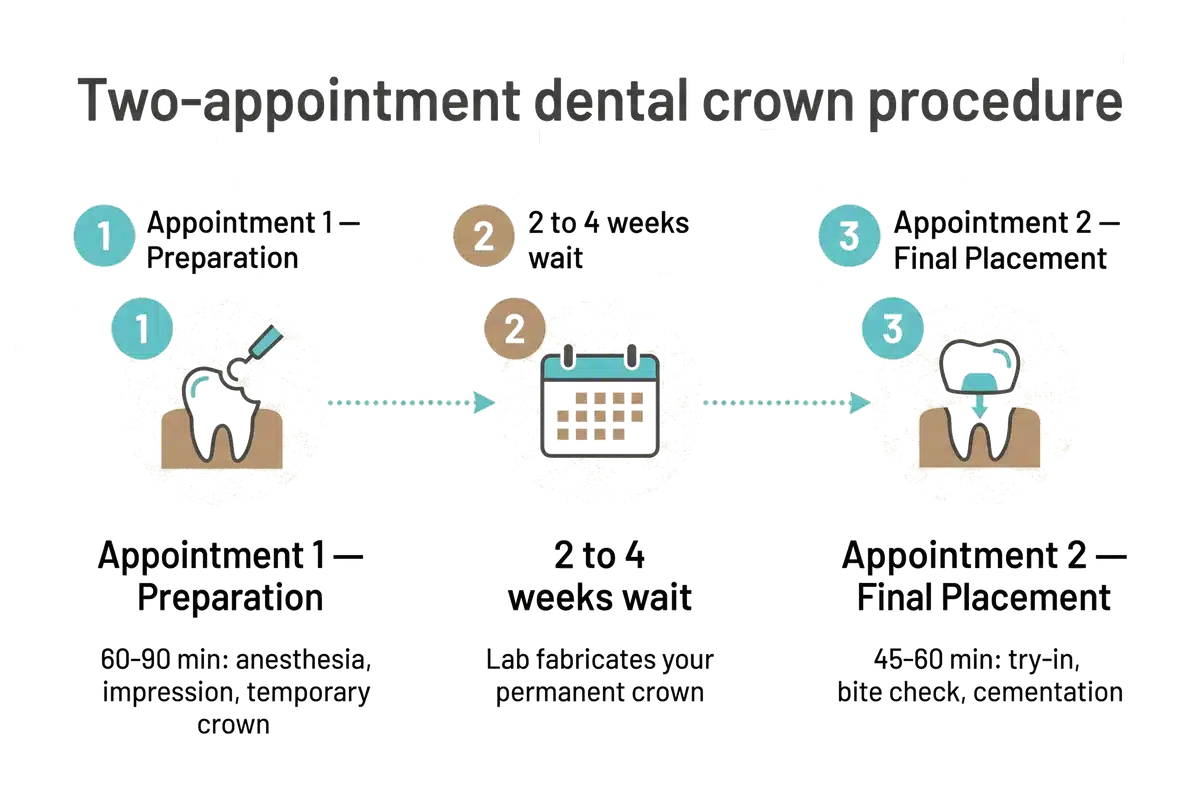
Placement follows the standard protocol described on our Crown and Bridge service page:
- 1st appointment (60–90 min) — Local anesthesia, tooth preparation, impression (digital or conventional), placement of a temporary crown.
- 2 to 4 week interval — The lab fabricates the custom permanent crown.
- 2nd appointment (45–60 min) — Removal of the temporary, try-in of the permanent crown, shade and bite verification, final cementation.
How to lower the cost of a crown without sacrificing quality
- Request pre-authorization from your insurer before placement — you’ll know your exact out-of-pocket.
- Spread major work across two calendar years if you need several crowns (the annual insurance cap resets).
- Check your eligibility for the CDCP (Canadian Dental Care Plan) if your family net income is below $90,000.
- Choose monolithic zirconia for a back molar: its longer lifespan (15+ years) often makes it the best value over a 20-year horizon.
- Avoid “$600 crown” promotions: those rates usually rely on non-certified labs or off-spec ceramics.
Frequently asked questions about dental crown cost in 2026
Why does the cost of a dental crown vary so much between clinics?
The gap comes mostly from the material, the lab used and the case complexity. A $700 crown may look attractive, but it is often made overseas without Health Canada traceability or uses a lower-density ceramic. In Quebec, a crown placed according to the ACDQ Fee Guide almost always falls in the $900 to $1,500 range, all inclusive.
Does a zirconia crown last longer than a porcelain crown?
Yes, in most cases. Monolithic zirconia has a flexural strength above 1,000 MPa, versus roughly 400 MPa for lithium disilicate (e.max) and around 100 MPa for traditional feldspathic ceramic. That’s why we recommend zirconia for molars and for patients who grind their teeth. For a front tooth, the translucency of e.max gives a slightly more natural-looking result.
Does dental insurance cover crowns in Quebec?
RAMQ does not cover crowns for adults. Private insurance plans cover them under the “major services” category at 50% to 80% of the ACDQ Fee Guide, up to the annual policy maximum. The Canadian Dental Care Plan (CDCP) can cover certain crowns for eligible patients, with pre-authorization. Centre dentaire Taschereau submits your treatment plan to your insurer before any work begins to confirm your out-of-pocket cost.
How long does a dental crown last?
With good hygiene (brushing twice daily, daily flossing, a check-up and cleaning every 6 months), a crown typically lasts 10 to 15 years — and 15+ years for zirconia. The main enemy is not the crown itself but recurrent decay at the junction between the crown and the natural tooth, which is why regular follow-up matters.
Is placing a crown painful?
No. The preparation is done under local anesthesia and is painless. Hot and cold sensitivity may persist for 1 to 2 weeks, especially if the tooth has not been devitalized. If sensitivity persists beyond 3 weeks, a return visit is needed — a bite adjustment usually resolves the situation.
Can a crown be placed on a dental implant?
Yes — it is the usual final step of a dental implant treatment. The implant crown is billed separately (typically $1,400 to $1,800 including the abutment), and the total cost of a complete implant case (surgery + abutment + crown) usually falls between $3,500 and $5,000 per tooth in Quebec in 2026.
What’s the price difference between a crown and a veneer?
A dental veneer ($700 – $1,200 per tooth) only covers the visible face of the tooth and preserves more of the natural structure. A crown ($900 – $1,500) covers the entire tooth and is indicated when the tooth is weakened or root-canal treated. For a purely aesthetic smile makeover on a healthy tooth, a veneer is usually the better choice.
Book a crown consultation in Brossard
An exact quote can only be confirmed after an exam and a targeted X-ray. The initial consultation includes a full diagnosis, costed treatment options, and a written estimate that can be submitted to your insurer for pre-authorization.
Centre dentaire Taschereau
8245 boul. Taschereau, suite A-14
Brossard, Quebec J4Y 1A4
Phone: (450) 912-1688
Article reviewed by the clinical team of Centre dentaire Taschereau, Brossard. The dentists at the clinic are members of the Ordre des dentistes du Québec and the Association des chirurgiens dentistes du Québec. The price ranges shown are indicative and based on the 2026 ACDQ Fee Guide. The final fee is confirmed in writing after the clinical examination. Last updated: May 2026.